

Custom Employee Name Tags With No Minimum Order
Table of Contents
- Why No Minimum Order Matters for Small Teams
- Material Types: Plastic, Metal, and Bamboo
- Magnetic Name Tags for Employees: A Clean, Hole-Free Option
- How to Choose Name Tag Fasteners
- Custom Name Tag Design Ideas and Readability
- Bulk Ordering vs. Single Unit Orders
- Production, Shipping, and Turnaround Times
- Frequently Asked Questions
Last Updated: September 17, 2026
Why No Minimum Order Matters for Small Teams
A five-person front desk team shouldn't have to order 100 badges to get professional identification. That's the reality with most suppliers, and it's why custom employee name tags no minimum is one of the most searched phrases among small business owners and HR managers. At Tag UR It! Inc., we removed that barrier: no minimums, no setup fees, no mock-up charges.
The U.S. Small Business Administration's employer data shows that most businesses in this country operate with fewer than 20 employees. Those are exactly the teams that get shut out by volume requirements.
This guide covers materials, fasteners, design, and turnaround so you can order exactly what you need, 8 badges or 80.
The Hidden Costs of Traditional Minimums
Minimums inflate the real cost of every order. Order 100 badges when you need 15 and you're paying for 85 that sit in a drawer. The per-badge price looks fine; the total doesn't, budget spent on inventory instead of growth.
How Tag UR It! Inc. Eliminates Setup Fees
Tag UR It! Inc. charges nothing to set up your logo, create a digital mock-up, or run a small batch, and you see the proof before production starts.
That matters most for the teams that need it: a restaurant opening a second location, a nonprofit ordering 20 recognition badges, a hotel refreshing front-desk identification. None should pay a penalty for ordering the right amount.
Material Types: Plastic, Metal, and Bamboo
The material you choose determines how the badge looks, lasts, and fits your brand. Three options cover nearly every use case.
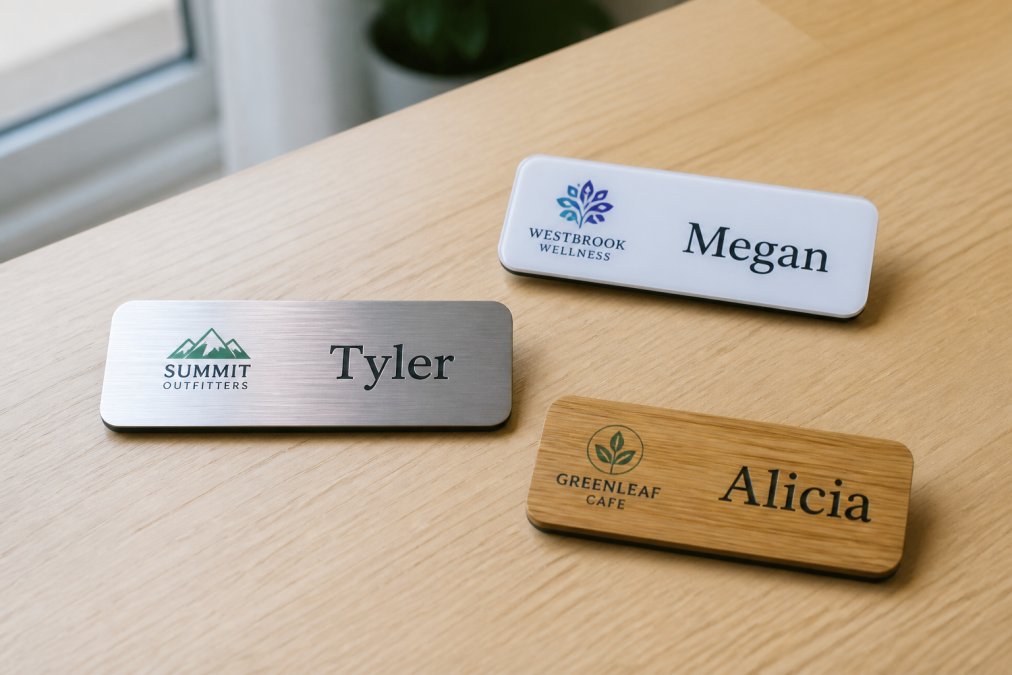
Plastic badges are the workhorse: lightweight, affordable, full-color, ideal for high-turnover teams and event credentials where cost per unit matters.
Metal badges carry weight, literally and visually, which is why hotels and polished restaurants prefer them. Laser engraving is crisp, scratch-resistant, and won't fade.
Bamboo is the newer option, gaining ground for its warm, sustainable look without sacrificing a professional appearance.
Durability and Finish Options
Finish is where cheap badges reveal themselves: thin laminate peels within months.
Magnetic Name Tags for Employees: A Clean, Hole-Free Option
Magnetic name tags for employees protect garment and wearer: no pins means no holes in a uniform shirt, no snagged fabric, no sharp point near the chest.
How to Choose Name Tag Fasteners
Choosing a name tag fastener comes down to three questions: What fabric does your team wear? How much movement does the job involve? Must the badge come off easily at shift's end?
Pin Backing vs. Clip vs. Lanyard Attachments
Each fastener solves a different problem.
- Pin backing: Traditional, secure on most fabrics, inexpensive. Leaves small holes in finer material and takes a moment longer to put on.
- Clip backing: Slides onto a pocket or lapel with no fabric damage. Fast, but can slide off during physical work.
- Lanyard attachments: Best for events and roles where a badge must be visible from a distance; the badge hangs rather than sits, changing up-close readability.
- Magnetic fasteners: No holes, no clips, no lanyard, the cleanest option for uniforms and professional dress.
Fastener |
Best For |
Fabric Impact |
Removal Speed |
|---|---|---|---|
Pin backing |
Uniforms, low-movement roles |
Leaves small holes |
Moderate |
Clip backing |
Office wear, blazers |
None |
Fast |
Lanyard |
Events, conferences |
None |
Fast |
Magnetic |
Hospitality, fine fabric |
None |
Fast |
Custom Name Tag Design Ideas and Readability
A name tag has one job: let a customer read a name from conversational distance. Everything else is secondary.
Logo Upload and Full-Color Printing
Uploading a logo takes minutes with the right file. Vector files scale cleanly to any size; high-resolution raster files work for most applications, but low-resolution images pulled from a website print soft.
Bulk Ordering vs. Single Unit Orders
Bulk ordering makes sense when outfitting a full team at once: per-unit costs drop because setup, handling, and shipping are amortized across more pieces. For a hotel rolling out identification across three departments, one bulk order means one proof, one approval, one shipment, and consistent branding.
The Real Cost Math of Over-Ordering
Minimums inflate the real cost of every order. Order 100 badges when you need 15 and you're paying for 85 that may never leave the box, so the invoice price stops telling the truth about what you spent.
Automating Reorders for New Hires
A no-minimum model makes it possible to treat name tags like any other onboarding supply. A few patterns that work well:
- Standing reorder triggers. When headcount crosses a threshold or a new hire is added to the HR system, a badge order is generated automatically.
- Portal-based ordering. Office managers or department leads log in to place single-unit orders against a pre-approved template, so only the name changes.
- Template libraries by role. Separate templates for front desk, clinical staff, and management keep a new hire's badge matching their team from day one.
- API or spreadsheet intake. An integration can push new-hire names and titles into an order queue; a shared spreadsheet with a defined column format is a workable middle ground.
When Bulk Still Wins
Bulk isn't obsolete. It's the right call when you're rebranding and every badge changes at once, opening a new location and need a full roster identified before day one, or ordering for an event with a fixed headcount. In those cases one bulk order beats twenty single-unit orders on price and consistency. The point isn't that bulk is bad, it's that you should choose it because it fits, not because a supplier won't let you order any other way.
Production, Shipping, and Turnaround Times
Turnaround depends on product, quantity, and finishing method. Simple plastic badges with printed names move quickly through a single print-and-finish pass. Engraved metal and bamboo take longer because each piece is finished individually, the laser traces every character, then the piece cools and is cleaned before shipping.
What Actually Drives Turnaround
A few variables move the clock more than anything else:
- Finishing method. Printed plastic is fastest; UV-printed plastic with a topcoat adds a step; laser-engraved metal and bamboo are slowest because they're piece-by-piece.
- Quantity. A single badge and a hundred don't take the same time, but under a no-minimum model the difference is smaller than you'd expect, setup is the same, only run length changes.
- Proof approval speed. The biggest variable you control: a proof sitting in an inbox for three days adds three days, no matter how fast production is.
- File quality. A vector logo drops straight into the layout; a low-resolution raster file needs cleanup or reprinting, and that back-and-forth costs time.
- Fastener type. Magnetic back plates and lanyard attachments are assembled after finishing, adding a small step at the end.
Maintaining and Cleaning Your Badges
A few maintenance habits that keep badges looking new:
- Wipe daily with a soft, damp cloth. A microfiber cloth and plain water handle most smudges; avoid paper towels, which leave lint and micro-scratches on glossy finishes.
- Skip alcohol and ammonia cleaners on printed plastic. They dull the topcoat and fade full-color printing. Mild dish soap diluted in water is safer for a deeper clean.
- For metal, a dry soft cloth is usually enough. Laser engraving won't rub off, but fingerprints and oils dull the finish; a quick wipe restores it.
- For bamboo, keep it dry. Wipe it down and let it air dry rather than submerging it.
- Sanitize with care in healthcare settings. Frequent hand contact and sanitizer residue are hard on any finish; a UV topcoat or laser engraving holds up far better than a bare printed surface.
Planning for Replacements
Even with good care, badges get lost, damaged, or outdated when someone changes roles. Under a no-minimum model, a replacement is a single unit, no penalty, no waiting for a bulk run. Keep a note of the original template (font, logo placement, finish) so a replacement matches the team exactly. That's the quiet advantage of a supplier who keeps your design on file: the tenth badge looks identical to the first.
Frequently Asked Questions
Can I order just one custom name tag?
Yes, Tag UR It! Inc. has no minimum order requirements. You can order a single custom employee name tag without paying setup fees or mock-up charges. This makes it easy for small teams or individual replacements. Simply upload your design, choose your material and fastener, and order exactly what you need.
What are the benefits of magnetic name tags for employees?
Magnetic name tags for employees avoid holes in clothing and stay securely in place without pins or clips. They offer a professional appearance and are easy to put on and remove. For hospitality and retail staff who wear delicate fabrics, magnetic fasteners prevent damage while keeping identification visible. They are also quick to swap between uniforms.
Are there setup fees for small-batch name tag orders?
No, Tag UR It! Inc. does not charge setup fees or mock-up charges, even for small-batch orders. You only pay for the tags themselves. This means you can order 5 or 500 tags without hidden costs. Pricing depends on quantity, material, and delivery timeline, so request a quote for your specific needs.
How long does it take to get custom name tags made?
Turnaround times vary based on material and order size, but Tag UR It! Inc. is known for fast production. For urgent events, contact customer service to confirm availability. Standard orders typically ship within a few business days after design approval. Rush options may be available.