

No Setup Fee Custom Name Tags: 7 Options
Table of Contents
- Why No Setup Fee Custom Name Tags Matter for Your Business
- Quick Comparison: Name Tag Options and Pricing
- Metal Name Tags: Beveled and Preferred Options
- Aluminum and Brass Name Tags for Lightweight Durability
- Plastic Name Tags: Budget-Friendly Customization
- Engraved vs. Printed Name Tags: Which Method Works Best
- Professional Name Tag Design Tips for Brand Impact
- Custom Employee Name Tags No Minimum: How to Order Small Quantities
- Frequently Asked Questions
Last Updated: September 25, 2026
Why No Setup Fee Custom Name Tags Matter for Your Business
At Tag UR It! Inc., no setup fee custom name tags eliminate hidden setup costs. You pay only for the badges themselves.
Small orders benefit most: 15 badges for a new hire cohort or seasonal event avoid setup charges that would double costs. Fewer hidden fees means better budgeting and faster decisions.
Quick Comparison: Name Tag Options and Pricing
| Material | Starting Price | Best For | Customization | Durability |
|---|---|---|---|---|
| Metal Beveled | $6.80 | Professional appearance, corporate events | Full-color sublimation | Excellent |
| Metal Preferred | $10.00 | Premium branding, upscale venues | Full-color sublimation | Excellent |
| Metal Frame | $5.75 | Budget-conscious, high-volume orders | Full-color sublimation | Excellent |
| Aluminum | $6.25-$6.95 | Lightweight needs, outdoor events | Full-color sublimation | Very good |
| Brass | $6.35 | Warm metallic finish, distinctive look | Full-color sublimation | Very good |
| Plastic | $5.10 | Entry-level, temporary staff | Printed or engraved | Good |
Metal options cost slightly more but deliver durability for permanent staff. Plastic works for short-term events or tight budgets. All options come with no setup fee, no minimum order requirements, and no mock-up charges.
Metal Name Tags: Beveled and Preferred Options
Metal badges project professionalism instantly.
The Silver Beveled Name Tag and Gold Beveled Name Tag start at $6.80 each. The polished outer edge with frosted face plate creates upscale appearance. Choose silver, gold, or white face plates; full-color sublimation prints logos and names in vibrant color without fading.


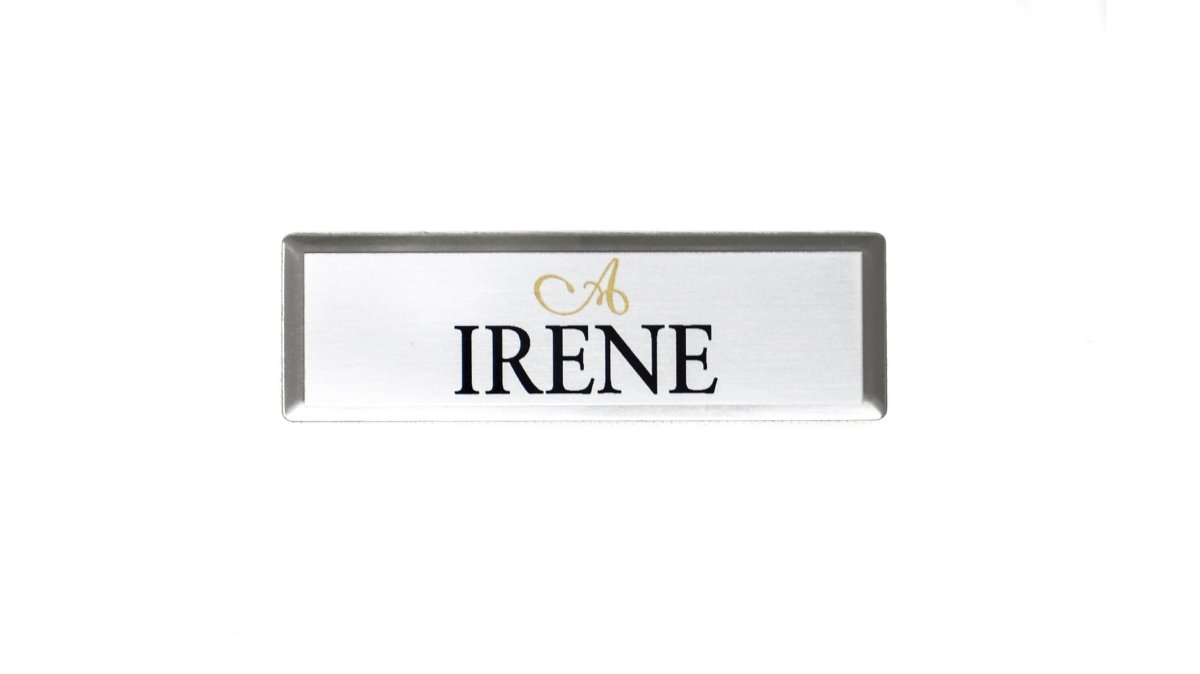
The Silver Preferred Name Tag and Gold Preferred Name Tag cost $10.00 each. The polished outer edge with frosted front surface creates refined appearance for upscale hospitality, executive teams, or premium branding. Multiple shapes and sizes available.

Both use sublimation printing, a heat-based process that bonds color directly into the face plates. This ensures durability without peeling or fading.
Aluminum and Brass Name Tags for Lightweight Durability
The Glossy White Aluminum Name Tag ($6.25) and Satin Silver Aluminum Name Tag ($6.95) are lightweight for all-day wear without neck strain, important for hospitality staff.
Both take full-color sublimation beautifully.
The Brass Name Tag ($6.35) features a brushed brass finish. Full-color printing keeps logos vibrant.
Plastic Name Tags: Budget-Friendly Customization
The Instabadge Brushed Gold/Black Plastic Name Tags ($5.10) deliver quality without cheap appearance.
Plastic works best for temporary staff, seasonal events, or high-turnover roles. You can print or engrave names at no extra charge.
Engraved vs. Printed Name Tags: Which Method Works Best
Engraved name tags cut text directly into material. Downside: slower, more expensive than printing, and limited color options.
Printed name tags use sublimation, bonding color directly into material. This delivers vibrant, full-color logos and multicolor designs that engraving can't match, why most professional branding uses printing.
For logos, printed badges can reproduce exact colors for brand consistency and handle gradients that engraving may not.
Professional Name Tag Design Tips for Brand Impact
Your name tags represent your brand in physical form. Effective design balances branding impact with readability and accessibility, especially in high-traffic environments like conferences and corporate events.
Logo and Artwork Specifications
Start with your logo at high-resolution (at least 300 dpi) and properly sized for badge dimensions. Test artwork at actual size before ordering.
Provide files in vector format (PDF, AI, or EPS) when possible; they scale without quality loss. If using raster images (JPG or PNG), ensure at least 1200 pixels wide. Avoid low-contrast logos; add borders or drop shadows for clarity on light backgrounds.
Font Selection and Readability Standards
Use sans-serif fonts (Arial, Helvetica, Calibri) that read clearly at small sizes. Avoid decorative fonts. Minimum 12-point for body text, 14-18 points for names and titles, ensuring legibility from 3-5 feet away.
Keep text contrast high: dark on light or light on dark. WCAG recommends 4.5:1 contrast ratio (Understanding Success Criterion 1.4.3: Contrast (Minimum) | WAI). Low contrast defeats the badge's purpose and creates barriers for those with visual impairments.
Accessibility and Inclusive Design Considerations
Accessibility in name tag design is often overlooked but increasingly important for corporate events, conferences, and inclusive workplaces. Consider these elements:
Color contrast for color blindness: Avoid red-green combinations as the sole differentiator. Add text labels or symbols so distinctions work without color alone.
Font size for visual acuity: Default to 16-point for names and 12-point for titles to accommodate diverse age groups and visual abilities.
Material finish and glare: Matte or satin finishes reduce glare from fluorescent or LED lighting, improving readability for all attendees.
QR codes and digital integration: If including QR codes, ensure at least 1 inch × 1 inch and test with multiple smartphones before printing.
Content Strategy: What to Include and Exclude
Include only essential information: name, title, and company name or logo. Every extra detail makes the design busier and harder to scan.
For event badges, consider adding department/role category ("Speaker," "Sponsor," "Attendee"), pronouns, and first name prominently.
For employee badges, keep it simple: first name, last name, title, and department. Avoid employee ID numbers on visible badges; if required for security, place them on the back.
Color Psychology and Brand Alignment
Tie color choices to brand identity and event goals. Blue and green convey trust (corporate events). Red draws attention but can feel aggressive. Gold/silver project upscale branding. Warm tones suit creative industries; cool tones suit formal settings.
Test colors under actual event lighting conditions. Request a physical sample before ordering your full batch.
Real-World Design Example
A well-designed badge features: company logo (1 inch, high contrast) upper left; first name 18-point bold; last name 14-point; title 12-point italic; department 10-point caps; pronouns 10-point; QR code 1.25 inches lower right. This layout uses 60% of badge face, prioritizes information hierarchy, maintains 4.5:1 contrast, and includes accessibility features.
Web Content Accessibility Guidelines (WCAG) 2.1 color contrast standards
Custom Employee Name Tags No Minimum: How to Order Small Quantities
At Tag UR It! Inc., order 1 badge or 1,000 at the same per-unit price. No setup fees. No hidden charges.
This changes small-order economics.
Integrating Name Tag Orders with Event Management and Registration Workflows
Event planners and HR teams manage attendee data through registration platforms, but name tag orders often exist in separate workflows, requiring manual entry and creating errors.
Ordering Timeline and Lead Time Planning
Plan your ordering timeline around your event date:
- 8+ weeks before: Order sample batch (5-10 badges) to verify quality and artwork.
- 4-6 weeks before: Place main order once registration is 80% complete.
- 2 weeks before: Order badges for late registrations.
- 1 week before: Order replacements for last-minute additions.
Practical Ordering Workflow for Event Coordinators
Step 1: Export and clean your data. Download attendee list, remove test entries and duplicates, verify required fields are populated, and use placeholder text for missing information.
Small Quantities for Ongoing HR and Onboarding Needs
New hire onboarding: Order custom employee name tags no minimum for each new hire as they join, rather than batching orders quarterly. This ensures every employee has a current badge from day one and eliminates the need to store excess inventory.
The combination of no setup fees, no minimums, and no mock-up charges removes friction from the ordering process. You're not penalized for ordering small. You're not locked into large quantities. You pay for the badges, nothing else. This flexibility integrates seamlessly into modern event management workflows and ongoing HR operations, making professional name tags accessible whenever you need them.
Frequently Asked Questions
What does 'no setup fee' mean when ordering custom name tags?
No setup fee means you won't pay extra charges for design file preparation, artwork processing, or initial production setup. With custom name tags no setup fee, your cost covers only the badges themselves and any finishing options like magnetic backing or pin fasteners. This eliminates hidden costs that other providers charge upfront, making small orders affordable for businesses, nonprofits, and event organizers.
Can I order custom employee name tags with no minimum quantity?
Yes. You can order as few as one badge. This flexibility works well for small teams, replacement orders, or testing a design before a larger purchase. You avoid bulk minimums and get the same professional quality whether ordering 5 tags or 500, with no additional per-unit charges for small quantities.
What's the difference between engraved vs printed name tags?
Engraved name tags have text or logos cut into the material surface. Printed name tags use full-color sublimation or direct printing, allowing vibrant logos, photos, and multi-color designs. Engraved tags cost more but suit minimalist corporate looks; printed options work best for branded designs with company logos. Both methods create professional, durable results.
How quickly can I receive custom name tags?
Fast turnaround times are standard. Most providers deliver within 5-10 business days from order confirmation, with rush options available if needed. Since there are no setup fees to delay production, your order moves directly to printing or engraving. Event coordinators and businesses needing tags for upcoming events can count on reliable delivery without lengthy wait times.
What materials work best for professional name tags?
Metal options like polished silver, gold, and brass offer premium durability and professional appearance ideal for corporate environments and hospitality staff. Aluminum tags provide lightweight alternatives with full-color printing. Plastic badges work well for events, temporary staff, or budget-conscious orders. Choose based on your industry: metal for upscale hotels and corporate offices, aluminum or plastic for nonprofits, events, and fast-moving environments where durability needs are lower.