

How to Choose Name Tag Material for Outdoor Events
Last Updated: November 5, 2026
Quick Summary
Choose name tag material by matching it to weather, event length, and reuse needs: plastic suits one-day dry events, fiberglass-reinforced plastic handles rain and humidity, and metal works best for multi-day or VIP-facing events. Compare cost per wear rather than sticker price, and order samples to test water, sun, and readability before bulk ordering.
- Ask how wet the event gets, how many days it runs, and whether badges will be reused.
- Sublimation fuses the print into a sealed surface so rain beads off instead of soaking in.
- Thin plastic can soften and curl in a hot car or on a table in direct sun.
- Matte finishes usually read better outdoors because they cut glare in bright sun.
- A $6.95 metal badge worn at four events a year for three years costs well under a dollar per event.
Table of Contents
- Start With Weather, Duration, and Reuse Needs
- Waterproof Name Tags: What Actually Survives Rain and Humidity
- Plastic Name Tags: Affordable and Light for One-Day Events
- Metal Name Tags: The Pick for Multi-Day and High-Profile Events
- Durable Name Tags for Events: Printing, Finish, and Attachment Choices
- Compare Materials by Cost, Readability, and Sustainability
- Order Samples and Build Your Outdoor Badge Set
- Frequently Asked Questions
Start With Weather, Duration, and Reuse Needs
How to choose the right name tag material for outdoor events starts with three questions, not a catalog. Ask how wet the event gets, how many days it runs, and whether you will reuse the badges. Organizers often order the cheapest badge, then find it curling in afternoon humidity. Badge material is a weather decision first and a design decision second.
Here is the short version. One-day, dry forecast: plastic. Rain in the forecast: fiberglass-reinforced plastic. Multi-day or VIP-facing: metal.
- Wet or humid? Water resistance matters most.
- One day or several? Reuse changes the math.
- Budget or keepsake? Compare the cost per use.
Match Material to Event Length
Event duration is the single best filter for name tag material. A one-day 5K fun run and a three-day trade show have almost nothing in common beyond the word "badge."
- A few hours: lightweight plastic is fine.
- One full day outdoors: plastic with rounded corners and a sealed print.
- Two to three days: metal or fiberglass-reinforced plastic.
- Recurring events: buy reusable, store flat.
A common mistake is buying for the event you have and not the event you repeat. If your team attends six outdoor events a year, a reusable badge pays for itself fast.
Waterproof Name Tags: What Actually Survives Rain and Humidity
Waterproof name tags need a sealed surface and a print that sits under or inside the material, not on top of it. Two materials pass that test: fiberglass-reinforced plastic and sublimated metal. Both resist water and humidity far better than paper or plain thermal-printed stock. But rain is only one outdoor condition.
Federal Emergency Management Agency guidance on flood and moisture damage to materials makes a simple point that applies here: prolonged moisture degrades porous materials, not sealed ones. Badge stock behaves the same way. The outdoor version of that lesson is that water resistance is a system, not a label.
Water resistance. The print must be under a sealed coating or fused into the material. Sublimation fuses the image into a coated surface so rain beads off instead of soaking in.
UV fading. Direct sun breaks down dyes over hours, not weeks. A badge that looks crisp at 9 a.m. can look washed out by mid-afternoon if the print is on the surface rather than sealed under it. Sublimated metal and fiberglass-reinforced plastic have a sealed print surface.
Heat and warping. Thin plastic can soften and curl in a hot car, on a dashboard, or on a table in direct sun. Fiberglass-reinforced plastic is reinforced with fiberglass, which is the reason this material is used for outdoor badges.
Humidity and condensation. A humid morning followed by a cool evening can leave condensation on any badge surface. Sealed coatings help shed moisture. This is the failure mode organizers miss most often, because the event never sees a single raindrop yet the badges still curl.
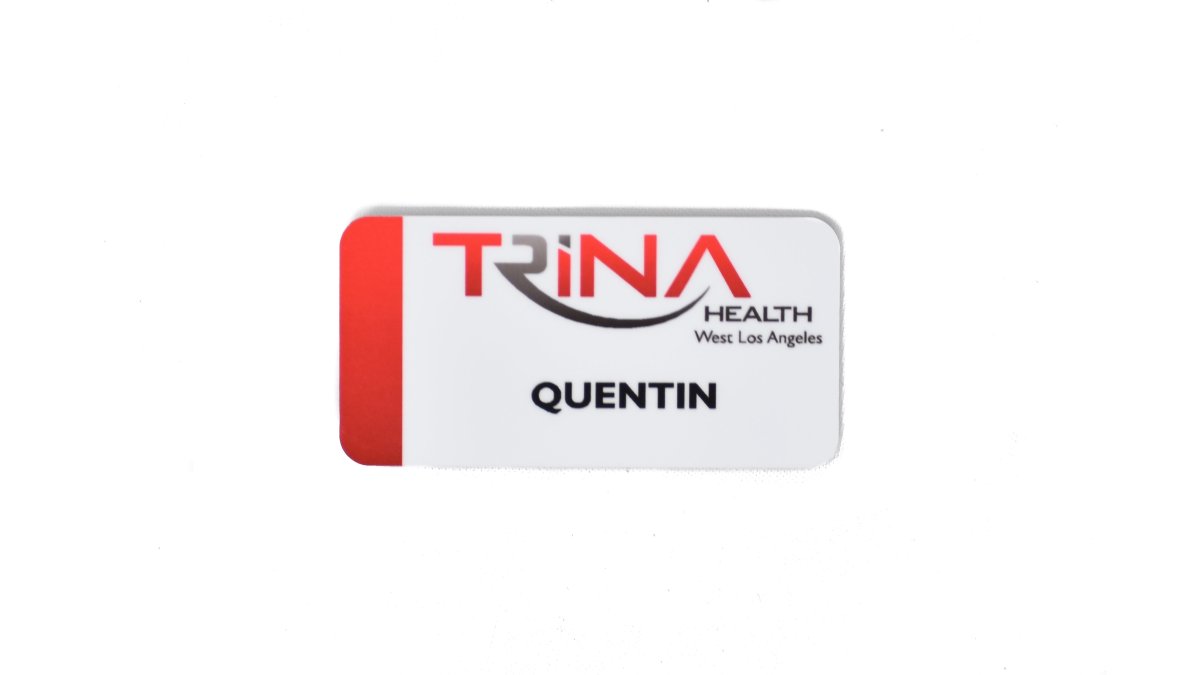
Our Unisub FRP name tags are a good example. Unisub FRP is fiberglass-reinforced plastic, about 3/32" thick, with a coating built for sublimation printing. Choose glossy or matte, and pick from multiple sizes. Matte hides glare and fingerprints in bright sun; gloss reads sharper in photos but shows smudges.

Watch out: a "waterproof" label on a paper insert tells you nothing about the holder around it. Check the whole badge, not just the card.
A simple field test settles most of this before you order in bulk. Spray a sample with water and let it sit for ten minutes, then wipe it and check for edge swelling. Leave a second sample in direct sun for a full afternoon and compare color against a stored control.
Plastic Name Tags: Affordable and Light for One-Day Events
Plastic name tags are the right call for one-day outdoor events with a dry forecast. They are light, cheap, and easy to print in full color. The trade-off is heat and long exposure: thin plastic can warp in direct sun and scratch in a tote bag.
Our white plastic Instabadge has rounded corners, full-color printing, and comes in multiple sizes. Rounded corners help avoid catching on lanyards and clothing.
- Best for: one-day fairs, walks, volunteer shifts
- Skip if: the event runs multiple days or sits in full sun for hours
Metal Name Tags: The Pick for Multi-Day and High-Profile Events
Metal name tags are a durable option for events where presence matters. If your badge will be photographed or worn three days straight, metal is the answer.
Two finishes cover most needs. The satin silver aluminum name tag has a brushed finish and comes in three sizes, sublimated in full color. The glossy white aluminum name tag is a lighter, brighter alternative in two sizes, also fully customizable with logos, names, and titles.


Aluminum name tags are lightweight.
- Best for: multi-day conferences, hospitality staff, VIP events
- Skip if: you need hundreds of disposable badges for one afternoon
Durable Name Tags for Events: Printing, Finish, and Attachment Choices
Durable name tags for events come down to three parts: the print method, the finish, and the attachment. Get any one wrong and a good material still fails outdoors.
Printing. Sublimation is the printing method used for this business's listed name tags.
Finish. Matte hides fingerprints and glare in bright sun. Gloss looks sharper in photos but shows smudges. For outdoor daytime events, matte usually reads better.
Attachment. This is where outdoor badges quietly fail.
| Attachment | Holds Best On | Outdoor Weakness |
|---|---|---|
| Lanyard | Multi-day events, staff | Flaps in wind, can twist the badge |
| Clip | Quick check-in lines | Pops off thin collars |
| Pin | Jackets, blazers | Leaves holes, snags knits |
| Adhesive | One-time guest badges | Lifts in heat and humidity |
A common mistake is pairing a heavy badge with a cheap clip. Use a lanyard with a wide strap for metal, and a clip for lightweight plastic.
Compare Materials by Cost, Readability, and Sustainability
Cost, readability, and disposal pull in different directions, so compare them side by side before you order. The table below uses the per-badge prices from the sections above; treat them as list prices for planning, not quotes, because size, finish, and quantity move the number.
| Material | Typical Price | Durability Outdoors | Best Event Length | Reuse |
|---|---|---|---|---|
| Paper / thermal stock | Lowest | Poor in damp | Hours, indoor | No |
| White plastic | $5.00 | Good, dry days | One day | Limited |
| Unisub FRP | $5.25 | Very good, wet weather | One to three days | Yes |
| Glossy white aluminum | $6.25 | Excellent | Multi-day | Yes |
| Satin silver aluminum | $6.95 | Excellent | Multi-day, high-profile | Yes |
The table hides the number that actually decides the budget: cost per wear. A $5.00 plastic badge used once costs $5.00 per event. A $6.95 metal badge worn at four events a year for three years costs well under a dollar per event. That is the total-cost angle most badge guides skip. Run the math on your own calendar before you compare sticker prices.
Readability depends on contrast and font size, not material alone, but outdoor light changes the rules. Bright sun washes out low-contrast pairings that read fine indoors. Keep names in a large, bold font, use dark text on light backgrounds, skip script fonts for outdoor light, and put the first name biggest. Test at arm's length in direct sun, not on a desk. Matte finishes usually read better outdoors because they cut glare; gloss looks sharper in photos but throws a hot reflection that can hide the name.
Sustainability depends on reuse first and material second. The greenest badge is the one you wear fifty times. After reuse, disposal mechanics matter, and this is where coatings and mixed materials complicate the picture. Check your local recycling program for guidance on disposing of name tags made from mixed materials.
U.S. Environmental Protection Agency guidance on reducing waste at events supports the reuse-first approach: durable goods beat disposables on waste every time you use them again. The practical version for badges is a collection plan. Put a labeled bin at check-out, collect reusable badges, wipe them down, and store them flat so they do not warp before next season. That one step keeps metal and FRP out of the trash and turns a per-event cost into a multi-year asset.
A short decision framework pulls the three columns together. If the event is one day and dry, pick the lowest-cost material and accept single use. If rain or humidity is likely, move up to a sealed material even for one day. If the event runs multiple days or repeats, buy reusable and calculate cost per wear. If the badge will be photographed or worn by VIP-facing staff, weight readability and finish above price. When two materials tie on cost per wear, choose the one with the simpler disposal path.
Order Samples and Build Your Outdoor Badge Set
Order samples before you commit to a full run. Material names alone do not tell you enough. "Plastic" covers many stock, and a sample in your hand settles questions that a spec sheet cannot.
U.S. Environmental Protection Agency guidance on reducing waste at events supports the reuse-first approach: durable goods beat disposables on waste every time you use them again.
Here is how we would build an outdoor badge set:
- List your events for the year and mark each as wet, dry, one-day, or multi-day.
- Pick two candidate materials per event type.
- Order a sample of each in your real size and finish.
- Test them outdoors: water spray, direct sun, a full day of wear.
- Check readability at arm's length in bright light.
- Place the bulk order once the sample passes.
Tag UR It! Inc. offers no minimum order requirements, no setup fees, and no mock-up charges, so testing a small batch first is easy. You can order custom name tags with no minimum to compare finishes before the full order. If you are short on time, ask about turnaround before you finalize the design.
Frequently Asked Questions
Which name tag material is best for outdoor events?
For outdoor events, metal and plastic name tags are both options, depending on event length and weather. Aluminum name tags are offered with full-color sublimation printing. Match the material to how long the badge must last and how much rain or humidity the event expects.
Are plastic or metal name tags better for outdoor use?
Plastic name tags cost less, starting around $5.00 for a white plastic Instabadge, and suit one-day outdoor events in dry weather. Metal name tags cost more, from $6.25 to $6.95 for aluminum options. If your event runs multiple days or the badge will be reused at future events, metal may suit your needs better.
How do you keep name tags readable in rain or humidity?
Choose a name tag with a sealed print method, such as sublimation on metal or fiberglass-reinforced plastic. Matte and gloss finishes are both available for the Unisub FRP name tags. Use a font large enough to read at arm's length, and attach the badge with a lanyard or clip that keeps it flat against clothing instead of flapping in wind.
How should I attach name tags to clothing at an outdoor event?
Lanyards and clips are common attachment options for name tags at outdoor events. Test your attachment choice on the actual uniform or shirt fabric before ordering in bulk.
Your next outdoor event is a test of planning, not luck. Pick the material by weather and duration, test a sample, and standardize on what survives. Tag UR It! Inc. makes that simple with no minimums, no setup fees, no mock-up charges, and fast turnaround on metal, plastic, and FRP badges. Get started with Tag UR It! Inc. and walk into your next outdoor event with badges that still look right on day three.
